
Take a young mouse. Put it in a cage with an old one for a month. Nothing measurable changes inside its brain — no plaques, no dead neurons, no shrinkage. And yet its memory falls apart. It forgets an object it inspected minutes earlier, and it loses its way in a maze it used to solve. The only thing that changed is which microbes live in its gut.
That is the opening move of a new paper in Nature from Timothy Cox, Maayan Levy, Christoph Thaiss and colleagues at Penn, Stanford and the Arc Institute [1]. It is worth sitting with because it turns the usual story about an aging brain inside out. We tend to picture memory loss as something that happens to the brain, from within. This work makes the case that a large part of it is done to the brain, from the gut.
The co-housing result on its own could be dismissed. Old mice are less active; maybe the young ones just picked up lazier habits. So the team ran the same experiment in germ-free mice, which carry no microbes at all. Housed with old cage-mates but unable to acquire their bacteria, the young mice stayed sharp. The social contact wasn't the problem. The transferred microbiome was. And it ran the other way too: germ-free mice allowed to grow old in isolation didn't develop the usual memory decline, and still learned and remembered normally at 18 months — an age at which a conventional mouse is well into cognitive decline.
The part that should make anyone selling a supplement pause: a course of broad-spectrum antibiotics reversed it. Wipe out the aged microbiome and the memory came back. This is not a fixed feature of an old brain. It is a signal an old gut keeps sending, and the signal can be switched off.
What the bad actor actually is
Across a lifespan cohort the team tracked more than a thousand bacterial species shifting with age. One kept rising to the top: Parabacteroides goldsteinii, more abundant in old animals and, crucially, transmissible. Give it to a young mouse on its own and cognition suffered. This wasn't a vague "dysbiosis" — it was a nameable bug with a nameable output.
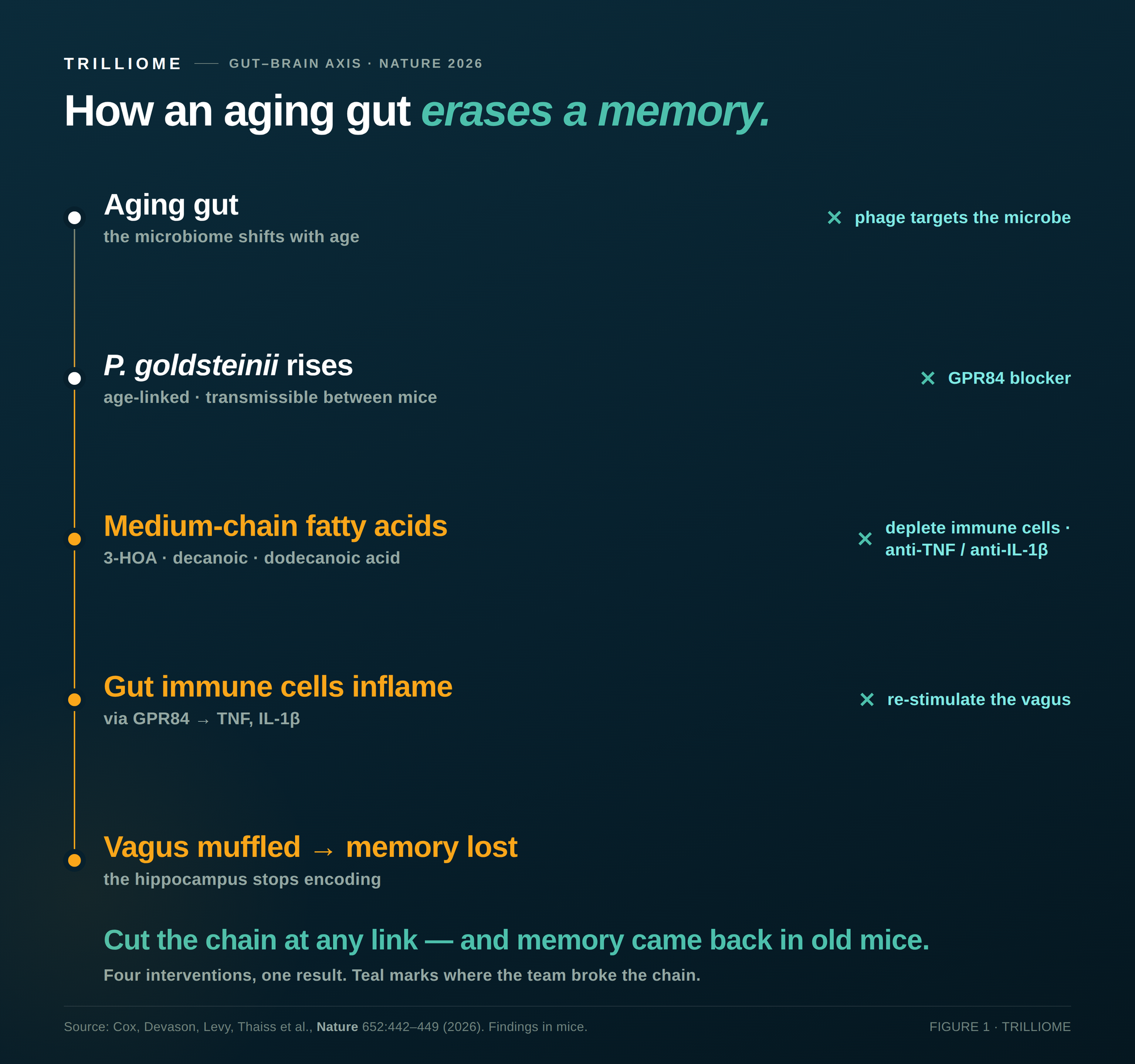
Here is where the chemistry matters, and where the easy headline gets it wrong. P. goldsteinii and its relatives pump out medium-chain fatty acids — 3-hydroxyoctanoic acid, decanoic acid, dodecanoic acid. Those molecules bind a receptor called GPR84, which sits almost exclusively on inflammatory immune cells (macrophages, monocytes, neutrophils) in the gut wall. Trip that receptor and those cells start releasing inflammatory signals like TNF and IL-1β. That local inflammation, in turn, dulls the vagus nerve — the main sensory cable carrying news of the gut up to the brain. With the cable muffled, the hippocampus stops firing when something new appears, and a new memory never gets written.
Gut microbe → medium-chain fatty acid → inflamed immune cell → silenced vagus nerve → a hippocampus that can't encode. Four links. And the team broke every one of them and got the memory back: a virus engineered to hunt Parabacteroides, a drug that blocks GPR84, depleting the inflammatory cells, neutralising the cytokines, or re-stimulating the vagus nerve directly. Any single intervention was enough to restore memory in old mice.
Which fatty acid, not how much
The lazy read of this paper is "gut fats rot your memory." That is exactly the read to avoid, and the reason is a distinction that gets flattened constantly.
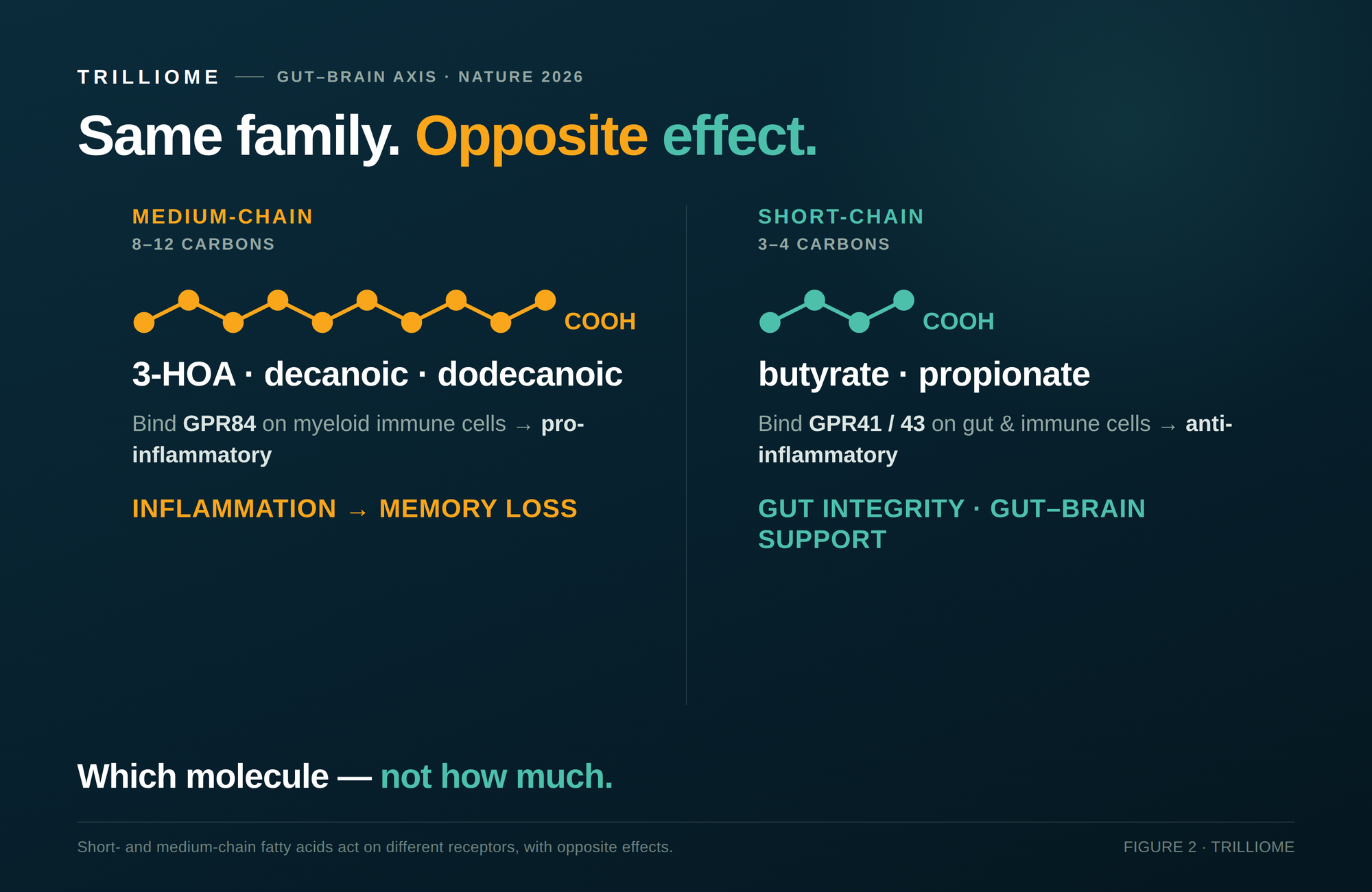
The molecules doing the damage here are medium-chain fatty acids, acting through an inflammatory receptor. They are not the same as the short-chain fatty acids — butyrate and propionate — that the same field spends most of its time celebrating for gut and brain health. Those act through entirely different receptors, and are broadly anti-inflammatory, feeding the gut lining and calming immune cells rather than provoking them. Same "fatty acid" umbrella on the label. Opposite chain length, opposite receptor, opposite effect.
Which is the real lesson buried in the mouse data. In the gut-brain axis, the identity of the molecule is the whole game. Not more microbes. Not more metabolites. The right ones, and the wrong ones, can be two carbons apart and point in opposite directions.
That distinction is the premise our own work is built on. Trilliome's approach isn't to flood the gut with bacteria or fibre and hope; it's to selectively amplify a defined set of beneficial short-chain-fatty-acid-producing species already living there — the calming, anti-inflammatory end of exactly the axis this paper maps. A study like this is a useful reminder of why precision, rather than volume, is the thing worth engineering for.
What we don't know yet
This is mice. The authors are unusually clear about it: it remains to be determined whether the same pathway drives age-associated cognitive decline in people. Human inflammation is messier, and P. goldsteinii is likely one of many triggers rather than the trigger.
But the framing they leave behind is the interesting part. They call the missing category of medicine "interoceptomimetics" — molecules that restore the gut's report to the brain rather than acting on the brain directly. If a peripheral signal you can reach by mouth can turn hippocampal memory encoding up or down, the question stops being "how do we fix the aging brain" and becomes "how much of what we call brain aging is actually a conversation the gut stopped having?" Nobody knows yet how much of the human answer looks like the mouse one. It is a very good question to be able to ask.
Reference
[1] Cox, T. O., Devason, A. S., Levy, M., Thaiss, C. A., et al. "Intestinal interoceptive dysfunction drives age-associated cognitive decline." Nature 652, 442–449 (2026). Published online 11 March 2026. https://doi.org/10.1038/s41586-026-10191-6