


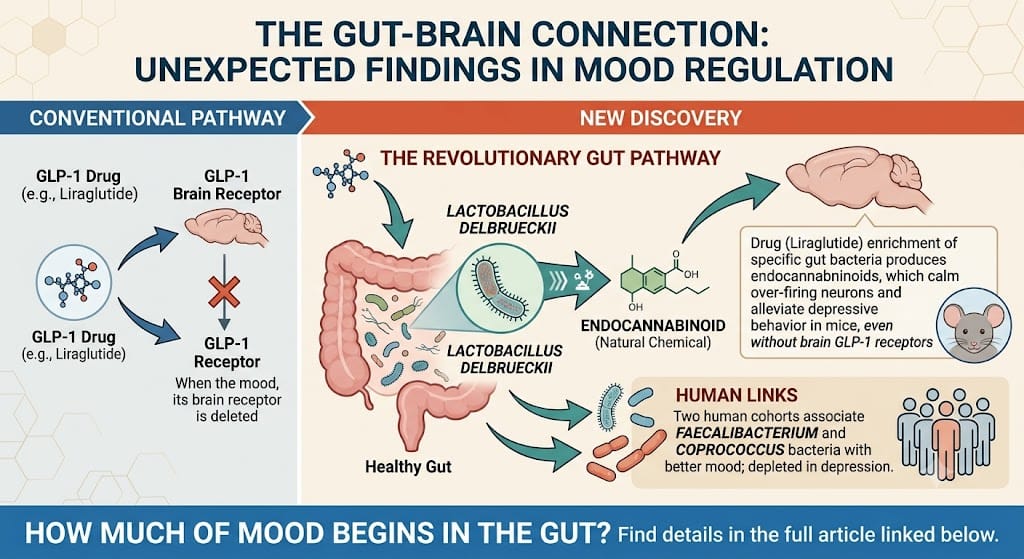
A GLP-1 drug relieved depression in mice. Then the researchers deleted the receptor it was supposed to act on, and it kept working.
The effect wasn't coming from the brain. It was coming from the gut.
This is from a study published in June 2026 in Cell Host & Microbe [1]. Liraglutide, the same drug class as Ozempic and Saxenda, reduced depressive behaviour in chronically stressed mice. It still worked in mice genetically engineered to lack the GLP-1 receptor, and it still worked when that receptor was blocked with a drug. It stopped working entirely in mice whose gut bacteria had been wiped out with antibiotics, and in germ-free mice raised with no microbes at all. The antidepressant effect needed the microbes, not the receptor.
The human signal that sent them looking: in a group of 40 healthy people and 30 with major depression, blood GLP-1 was lower in the depressed group, and the lower it ran, the more severe the symptoms [1]. That is a correlation in people, not yet a treatment in people. It was enough to justify the question.
What the bacteria were actually doing
The drug enriched one species, Lactobacillus delbrueckii. That bacterium supplies a fat-derived building block the body then converts into 2-arachidonoylglycerol, or 2-AG. 2-AG is an endocannabinoid, one of the molecules your own body makes to act on the same receptors that cannabis does. The extra 2-AG reached the brain and quietened over-firing neurons in two stress-related regions, and the depressive behaviour lifted. Block the cannabinoid receptor, and the benefit vanished.
The part I find most striking is how the drug grew the bug. In pure culture, with no animal involved, liraglutide fed the microbe's own metabolism, raising its production of serine and PEP, two molecules a cell needs to build copies of itself. Supply those two directly and the bacterium grows just as well, no drug required. A peptide hormone, steering a single species by feeding its chemistry. The authors are careful to say they don't yet know how the drug physically reaches the bacterium in the first place [1].
Not an isolated result
A single mouse study is a hypothesis, not a fact. What makes this one worth your attention is where it lands: a field where the human evidence has been accumulating for years, and where the same bacteria keep reappearing.
Two large population studies, in different countries, found a matching pattern. The Flemish Gut Flora Project profiled more than a thousand people and confirmed the result in a thousand more: those with higher levels of the butyrate-producing genera Faecalibacterium and Coprococcus reported better quality of life, while Coprococcus and Dialister were depleted in people with depression, even after correcting for antidepressant use [2]. A Rotterdam and Amsterdam study of more than 2,500 people then independently linked around a dozen bacterial groups to depressive symptoms, many of them involved in making serotonin, butyrate, glutamate and GABA, the brain's own chemical messengers [3].
Does taking probiotics actually help?
Here the evidence is genuinely mixed, and worth reading both ways. A 2024 meta-analysis pooled 23 randomized controlled trials, roughly 1,400 patients, and found probiotics produced a real reduction in depression symptoms and a smaller reduction in anxiety. In the same analysis, prebiotics did not reach significance for depression, and the effect sizes varied widely between studies depending on which strains were used [4]. A separate randomized trial added a 14-strain probiotic on top of standard antidepressants in 49 people with major depression and saw greater improvement than placebo over eight weeks [5].
Against that, a carefully run trial of a single strain in 184 pregnant and postpartum women found no mood benefit at all, and the strain wasn't even detectable in many of the women who had taken it by the end of the study [6]. That last detail matters more than it looks: you can swallow a bacterium and still not have it take up residence.
How a microbe in the gut reaches a mood
Three routes are now reasonably well mapped, and the antidepressant effect usually runs through more than one at once.
The vagus nerve is the direct line. A landmark 2011 study fed mice a Lactobacillus rhamnosus strain and saw reduced anxiety, lower stress hormones, and altered GABA receptors in the brain. Cut the vagus nerve and the effect disappeared, which placed the signal squarely on that nerve [7]. (Mouse.)
Short-chain fatty acids are the chemical route. When gut bacteria ferment fibre they release butyrate, propionate and acetate. These reach the bloodstream and influence the gut lining, the immune system and the brain, including the production of neuroactive signals [8]. (Review of mostly preclinical work.)
Endocannabinoids are the route the new GLP-1 study lands on, and it isn't the first to find it. A 2020 study showed that transplanting gut bacteria from stressed mice into healthy ones transferred the low mood, that the transfer came with a drop in endocannabinoid signalling, and that a Lactobacillus strain reversed it [9]. The 2026 paper supplies the missing specifics: which bacterium, and the exact chemistry [1]. (Both mouse.)
Most of the precise mechanism work is still in animals. The human work is mostly associations plus a still-uneven set of trials. The direction is consistent across both; the proof in people is not finished. That gap is the honest state of the field, and pretending otherwise helps no one.
Where this connects to what we do
This is the science we work in at Trilliome, and one practical problem runs through all of it. The gut species most strongly linked to brain and metabolic health are strict anaerobes: they die on contact with oxygen. That is why a probiotic capsule so often delivers the wrong organisms, or organisms that never establish. The postpartum trial above is a clean illustration. You cannot reliably deliver the bugs that matter most.
So we don't try to. Our approach is to switch on the beneficial species already living in a person's gut, using plant-derived molecules, at small and specific doses chosen to move particular species rather than feed everything indiscriminately. One of our lead programmes induces a named four-species consortium that includes Coprococcus catus, from the very Coprococcus group the population studies above flag as depleted in low mood. The discovery engine behind it, which we call Teroka, exists to work out which molecule moves which species. The brain benefits described in this post need human clinical evidence before anyone, ourselves included, should claim them. Generating that evidence is what our programme is built to do.
For a century we have treated mood as something that happens above the neck. The more carefully people look, the more of it seems to begin lower down, in an ecosystem we are only starting to learn how to steer. If a diabetes drug can lift depression by feeding one gut bacterium, how much of what we treat in the brain actually begins in the gut?
References
[1] Microbiota-driven gut-brain signaling underlies antidepressant effects of a GLP-1 analog (Bian et al., 2026, Cell Host & Microbe)
[2] The neuroactive potential of the human gut microbiota in quality of life and depression (Valles-Colomer et al., 2019, Nature Microbiology)
[3] Gut microbiome-wide association study of depressive symptoms (Radjabzadeh et al., 2022, Nature Communications)
[4] Effects of prebiotics and probiotics on symptoms of depression and anxiety in clinically diagnosed samples: systematic review and meta-analysis of randomized controlled trials (Asad et al., 2024, Nutrition Reviews)
[5] Acceptability, tolerability, and estimates of putative treatment effects of probiotics as adjunctive treatment in patients with depression: a randomized clinical trial (Nikolova et al., 2023, JAMA Psychiatry)
[6] The impact of ingestion of Bifidobacterium longum NCC3001 on perinatal anxiety and depressive symptoms: a randomized controlled trial (Fries et al., 2025, Scientific Reports)
[7] Ingestion of Lactobacillus strain regulates emotional behavior and central GABA receptor expression in a mouse via the vagus nerve (Bravo et al., 2011, PNAS)
[8] Short chain fatty acids: microbial metabolites for gut-brain axis signalling (O'Riordan et al., 2022, Molecular and Cellular Endocrinology)
[9] Effect of gut microbiota on depressive-like behaviors in mice is mediated by the endocannabinoid system (Chevalier et al., 2020, Nature Communications)